A lot of contractors searching for wheel loader rental costs underbuy or overbuy by one size class. The published rate is the easy part. Picking the right machine for the work is harder, and that’s where the budget moves.
Below is what a wheel loader rental runs across Western Canada, what changes your quote, and which size class fits the job you’re scoping. If you’re pricing a mixed fleet for a project, our full breakdown on heavy equipment rental costs in Western Canada covers skid steers, excavators, compaction, and compressors alongside wheel loaders.
A wheel loader rental in Western Canada runs roughly $441 to $1,635 per day, $1,715 to $6,050 per week, or $4,215 to $15,950 per month, depending on bucket size and weight class. Compact 1.0 to 1.5 yard machines sit at the bottom of each range, 4.5 to 6.5 yard production loaders at the top.
Table of Contents
What a Wheel Loader Rental Costs in Western Canada
These ranges reflect Plains’ 2026 rates for wheel loader rentals across our Edmonton, Calgary, and Lethbridge locations. Every rate is a 10-hour day, a 50-hour week, or a 200-hour month. Bigger machines and longer runs sit at the top of each tier.
| Size Class | Operating Weight | Day Rate | Weekly Rate | Monthly Rate |
|---|---|---|---|---|
| Compact (1.0 to 1.5 yard) | 10,000 to 14,500 lb | $441 to $535 | $1,715 to $1,825 | $4,215 to $4,820 |
| Mid-Size (2.0 to 3.5 yard) | 24,000 to 35,000 lb | $715 to $865 | $2,350 to $2,700 | $7,250 to $8,350 |
| Production (4.5 to 6.5 yard) | 42,000 to 61,000 lb | $1,000 to $1,635 | $3,300 to $6,050 | $10,835 to $15,950 |
Note: Seasonal monthly rates run roughly 5 to 15 percent below the standard monthly rate for committed long-term contracts. If your project length is locked in, ask about it on the quote.

Picking the Right Wheel Loader Size
The biggest single lever on a wheel loader rental isn’t the day rate or the season. It’s whether you’ve picked the right size class for the work. If you’re still weighing types and uses, our guide to wheel loaders covers how the classes differ before you land on a size.
Under-rent and you’ll burn through man and machine hours grinding through cycles. Over-rent and you’re paying weekly for capacity you’re not using. Many contractors land in the middle, and the middle is also where the common sizing mistakes happen.
We’d rather walk through your job on a quick call than guess at a quote. A lot of the time the machine someone thinks they need isn’t the one that fits the work best, or there’s an attachment available that allows them to utilize a smaller machine over a higher-priced larger unit. Five minutes on the phone catches that before it costs anyone money.
Compact (1.0 to 1.5 Yard)
Operating weight from 10,000 to 14,500 lb. Compact wheel loaders fit residential builds, light contractor work, and tight urban sites where access matters more than cycle volume. You can transport a 1.0 yard on a heavy-duty gooseneck or bumper-pull trailer, which keeps mobilization simple and cheaper then a large semi-truck and trailer.
The published rate is $441 to $535 per day, $1,715 to $1,825 per week, or $4,215 to $4,820 per month.

Mid-Size (2.0 to 3.5 Yard)
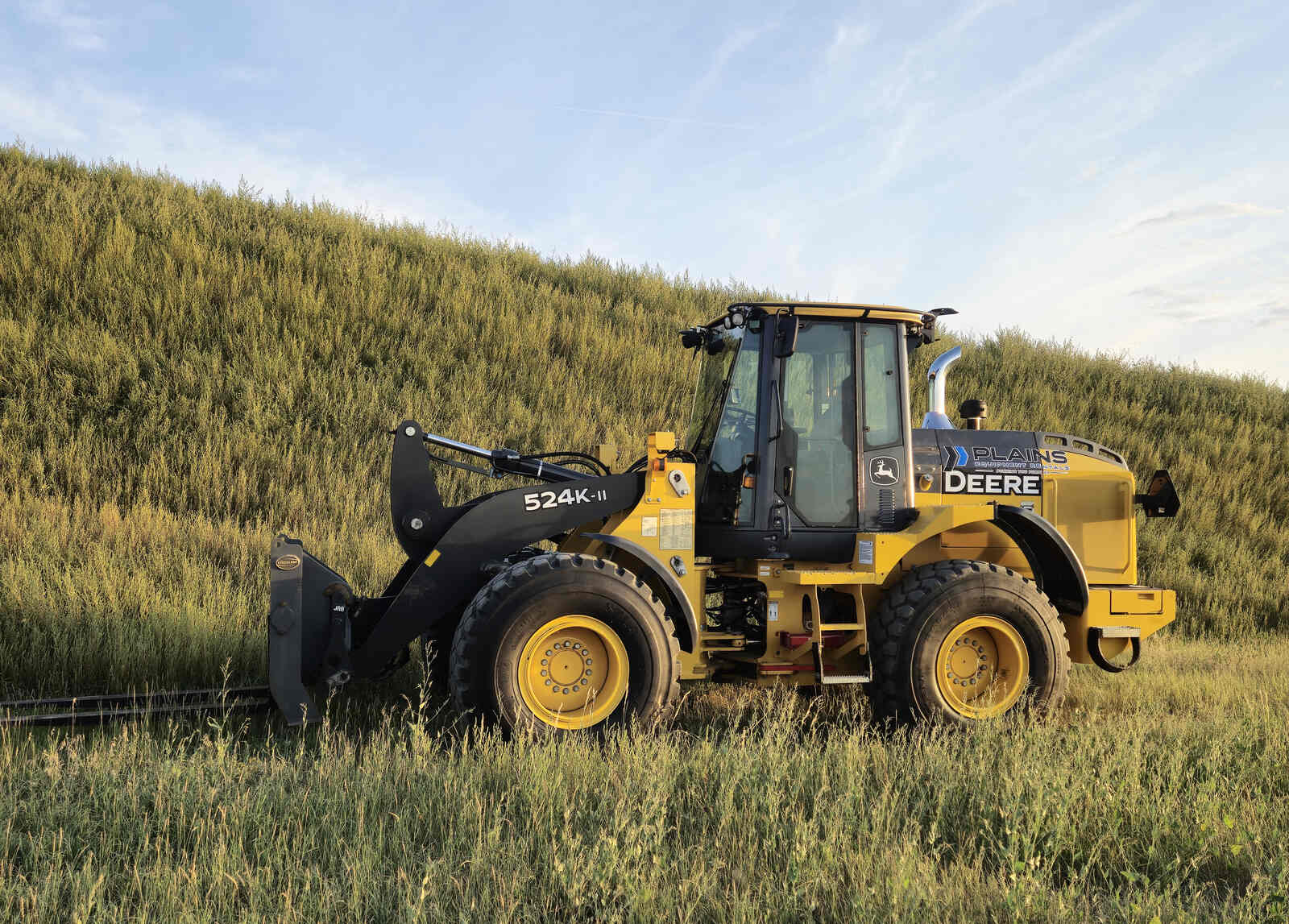
Operating weight from 24,000 to 35,000 lb. Mid-size loaders are the workhorse class across Western Canada. They handle commercial snow contracts, general contractor work, mid-yard loading, and aggregate and pipe handling on a lot of large and small commercial sites.
If your job needs a wheel loader and you’re not sure which size, this is usually the right starting point.
The published rate is $715 to $865 per day, $2,350 to $2,700 per week, or $7,250 to $8,350 per month.
Production / Large (4.5 to 6.5 Yard)
Operating weight from 42,000 to 61,000 lb. Production loaders move bulk material efficiently. Aggregate operations, salt loading on municipal contracts, large-volume commercial snow, mining-adjacent work, fertilizer terminals, anywhere cycle time per ton is the constraint instead of access or footprint.
These machines also need heavy-duty haul capacity to mobilize, which is one reason they sit at the top of the rate range.
The published rate is $1,000 to $1,635 per day, $3,300 to $6,050 per week, or $10,835 to $15,950 per month.
How Wheel Loader Hire Charges Are Calculated
Plains charges in blocks, not by the hour. Each block has a clear hour cap, and overtime past the cap is billed transparently at a published hourly rate.
The four rate tiers:
- Daily: 10 hours of run time included. Best for short jobs of 1 to 4 days.
- Weekly: 50 hours of run time included. Best for projects of 1 to 3 weeks.
- Monthly: 200 hours of run time included. Best for projects of 3 weeks to several months.
- Seasonal Monthly: Lower than normal hour allotment, minimum 3-month commitment. Runs 5 to 15 percent below the standard monthly rate. Best for commercial snow contracts and long-duration site work.
Here’s how the math lands on a 4-week job with a 2.5 yard wheel loader at Plains’ published rates:
- 28 days at the daily rate: 28 × $715 = $20,020
- 4 weeks at the weekly rate: 4 × $2,410 = $9,640
- 1 month at the monthly rate: $7,500, with up to 200 hours of run time included
The day rate is for genuinely short jobs. Past about 3 to 4 days, the weekly almost always quotes cheaper, and past three weeks the monthly is the answer. If your project is locked in for 3+ months on the same machine, the seasonal monthly cuts another 5 to 15 percent off the top if the rental company your using offers seasonal pricing.

What Changes Your Wheel Loader Rental Quote
Six levers shape every wheel loader quote.
1. Size Class and Bucket Capacity
The largest single lever. A 1.5 yard compact handles small residential snow at $4,820 per month. A 6.5 yard production loader handles aggregate at $15,950 per month. Picking the right class is worth more than any other decision you’ll make on the quote.
2. Rental Duration
Day, week, month, and seasonal monthly blocks aren’t packaging tricks. They reflect real economics: longer runs mean less inbound and outbound logistics, less yard cycle time, and predictable utilization. Plains passes that math through. If your project is more than four days, ask about the weekly. More than three weeks, ask about the monthly. Three months or more, ask about seasonal.
3. Season
Wheel loader demand peaks twice a year: snow season from November through April, and construction season from May through August. Shoulder months in April and September, October usually have the best availability and the easiest access to seasonal monthly pricing.
4. Standard Included Hours and Overtime
Plains’ day, week, and month rates include 10, 50, and 200 hours of run time, respectively. That’s higher than the 8-hour day you’ll see on a lot of national rental chain quotes. If your crew runs the machine harder, overtime is billed separately at a published hourly rate, not buried in a fee schedule. Ask up front so it’s on the quote.
5. Attachments
A standard bucket comes included. Sectional Sno-Pushers, snow blades, and forks are quoted separately. The right attachment can shift productivity hard: a single machine running a 14-foot Sno-Pusher can outwork three machines running buckets on commercial snow contracts, that’s two less machines and operators you have to worry about. Renting the attachment with the machine almost always costs less than booking it standalone.
6. Delivery
This is where a lot of rental quotes hide cost. Plains doesn’t operate a fixed haul fleet. We work through a carrier network and our own trucks that route through Western Canada, which means delivery is quoted against real haul distance instead of a padded flat rate.
Snow Season vs Construction Season
Wheel loaders are one of the few machine classes that hit two demand peaks a year.
Snow season (November to April): commercial snow contracts, salt loading, pile management at municipal yards, route work for property managers. Demand spikes through November and stays high until thaw.
Construction season (May to September): aggregate handling, site prep, materials loading, general contractor work. Demand spikes through May and runs hot until October.
Shoulder months (April and October): the cheapest months to rent a wheel loader. Construction is winding down, snow hasn’t started, availability is wide open, and seasonal monthly pricing is easiest to access.
If your project timing is flexible, booking in a shoulder month often unlocks the seasonal monthly rate even on shorter commitments. If you’re scoping a commercial snow contract for next season, the conversation worth having is whether seasonal monthly across 5 or 6 months beats a stack of one-month rentals, which it almost always does.

Renting a Wheel Loader Before You Buy
A common question that lands here: should you lease, buy, or rent?
Lease rates look attractive on paper. They tie up capital for years, and the maintenance, insurance, downtime risk, and resale risk all shift to you. If the machine goes down, warranty or no warranty, it’s on you to find a replacement to keep the work moving. With renting, that’s on Plains.
For a 3 to 6 month run on a single machine, our seasonal monthly rate often lands not much higher than a lease payment once you calculate in all the hidden risks and additional costs, with none of the multi-year commitment. For a contractor weighing a real purchase, a rental period on the specific unit you’re considering is the cleanest way to test the fit before you commit. You get a real read on cycle time, fuel burn, operator comfort, and serviceability before you sign for a $200,000+ asset.
That same logic plays out whether you’re comparing Cat, Komatsu, Volvo, John Deere, Case, or Chinese-brand wheel loaders. Rent the one you think you want, work it on a real job, and you’ll know.
Common Questions About Wheel Loader Rental Costs
How Much Does a Seasonal Wheel Loader Rental Cost?
Seasonal monthly rates run 5 to 15 percent below the standard monthly rate, with a minimum 3-month commitment. Compact 1.0 to 1.5 yard machines land in the $3,800 to $4,200 range per month. Mid-class 2.0 to 3.5 yard machines run roughly $6,100 to $7,100. Production 4.5 to 6.5 yard machines run from about $9,200 to $12,800. Each includes a lower than the monthly amount of run time per month across the season block.
What Do Most People Underestimate About Owning a Wheel Loader vs Renting?
The line items that don’t show up on the purchase price. Maintenance, repairs and breakdowns, parts, insurance, storage between jobs, depreciation, and the resale headache when you’re done with it. Then there’s the part that catches owners off guard: when a machine goes down on a Friday afternoon, you’re the one tracking down a tech, a part, and a backup unit to keep your crew moving. With a rental, that call goes to us, and getting you back up and running is on our shoulders. It’s a big part of why more construction companies are moving to long-term rentals over buying.
Do I Need a License to Operate a Wheel Loader in Alberta?
Alberta doesn’t require a provincial license to operate heavy equipment on private property or active jobsites. What you do need is documented operator competency under Alberta OHS rules, which means the operator has been trained and assessed on the specific machine class. Larger contractors usually verify this through internal training records or third-party tickets. If the machine is being moved on public roads, road regulations and licensing apply separately.
Plains Wheel Loaders Across Western Canada
Plains stocks various wheel loader sizes at our Edmonton, Calgary, and Lethbridge yards.
Carrier Network Delivery
Plains works through strategic carrier partnerships rather than running a fixed haul fleet. On any given week, one of those carriers is already running a route near your jobsite. Sometimes that means loading two of our machines in a single trip, which saves a deadhead leg and keeps the delivery line on your quote honest.
Standard Inclusions
Every wheel loader rental includes a standard bucket and the published hour allotment (10 daily, 50 weekly, 200 monthly). Optional Plains Protection Plan (PPP) coverage can be added to any rental for damage and loss protection.
One Point of Contact
Carrier coordination, delivery scheduling, overtime questions, and the “we lost a hose at 4:45 PM” calls all go through your Plains rep. We handle the repair and coordination so you can stay focused on the job.
Talk Through Your Wheel Loader Rental With Us
The wrong wheel loader on the right job is a budget problem, and the right wheel loader on the wrong attachment is a productivity one. Both happen every day somewhere in Western Canada.
The part that doesn’t show up on a rate sheet is the part we’d rather work through on a phone call. A lot of contractors come in convinced they need a 3.5 yard when a 2.5 yard with the right attachment will outrun it on their site. Some show up asking for a compact when the cycle math says a mid-size pays for itself inside a week. A five-minute call usually sorts that out faster than any quote form will.
So if you’re scoping a job and not sure whether a 2.0 yard or a 3.0 yard fits, whether seasonal monthly beats four months of standard rentals, or whether the machine you think you need is the one that fits the work, give us a call before you sign anything. We use transparent, usage-based pricing so you’re paying for what you plan to use, not an inflated rate built around assumed high usage. And if you’re weighing a real purchase, a rental period on the specific unit is the cleanest way to test the fit before you commit, which saves the headache and the resale cost if the impulse buy wasn’t the right call.
Get a wheel loader quote and we’ll get you on a quick call to walk through the size, season, and setup that fits the job best.